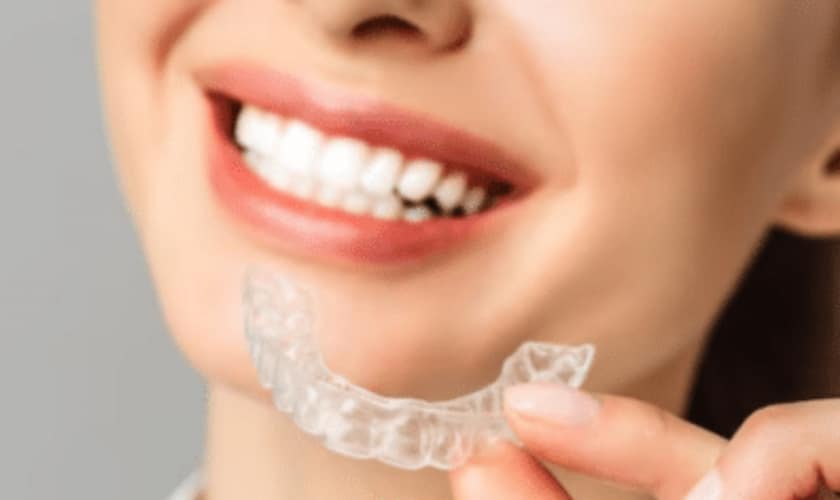
Does Invisalign Really Work Without Causing Tooth Problems
Does Invisalign really work? This treatment is often marketed as a more convenient alternative to braces, but some patients are concerned about its effectiveness. Invisalign® may sound too good to be true — patients do not have to worry about avoiding certain foods that may become stuck in traditional braces.
Does Invisalign really work?
Like traditional braces, Invisalign® is designed to correct crooked teeth, crowded teeth and gaps. Instead of periodically having wires tightened like with braces, Invisalign® patients are given a series of near-invisible aligners. Each successive set of aligners is designed to push the patient’s teeth closer to their ideal alignment.
What factors cause Invisalign® not to work?
One of the advantages of
Invisalign® is that it can be taken out when a patient needs to eat or brush their teeth. However, this advantage can quickly become a disadvantage when patients are non-compliant. Most dental professionals advise their patients that they need to wear their Invisalign® trays as close to 23 hours per day as possible.
Because it is easy to remove Invisalign® at any point, some patients go for several hours without wearing their aligners. Even in this relatively short period, it is possible to lose progress. Each time a patient goes without aligners, teeth can shift back to where they were before treatment. When done frequently, this can result in Invisalign® treatment not working.
Does Invisalign really work for all dental issues?
Invisalign® can be used to correct almost every issue that traditional braces can. However, for certain severe issues, a patient’s dentist may recommend alternative treatment. For patients with the following issues, Invisalign® may not be effective:
-
- Extremely crowded teeth
- Teeth rotated more than 20 degrees
- Very large gaps between teeth
- Existing dental bridges or similar types of dental work
- Unusually shaped teeth
Before prescribing Invisalign® or a similar orthodontic treatment, a dental professional will thoroughly examine a patient’s teeth to see whether Invisalign® is the right option.
Can Invisalign® cause tooth problems?
When used correctly, Invisalign® will not cause tooth problems. Patients do need to be very careful to brush their teeth before putting aligners back in. Because aligners fit very tightly to the teeth, they stop saliva from reaching the teeth’s surface. Without saliva, food particles cannot be efficiently broken down, and plaque, cavities and other dental issues may occur.
In order to avoid potential problems, Invisalign® patients should make sure they brush and floss their teeth after eating and before placing the aligners. The prescribing provider will usually go over optimal dental hygiene with a patient before fitting them with their first set of aligners.
Patients who have been wondering,
“Does Invisalign® really work?” may be relieved to know that with careful compliance and good dental hygiene, the answer is almost always yes. For patients interested in Invisalign® for achieving a better smile, it is a good idea to
reach out to a dental professional to make an appointment.
Related Posts
You have tried whitening strips, whitening toothpaste, and maybe even a professional treatment. Yet your smile still looks dull or discolored. If you are wondering why your teeth whitening isn't working, intrinsic vs. extrinsic stains in Boca Raton could be the answer. Not all stains respond to whitening the same way — and understanding the…
If you are considering full-mouth restoration in Boca Raton, one of the first questions you probably have is: how long will the results actually last? It is a fair and important question. You are investing in your smile, your health, and your quality of life. Understanding the longevity of full-mouth restoration results in Boca Raton…
If you've been wondering why your dentures feel loose after a few years in Boca Raton, you're not alone. Many denture wearers notice a gradual change in fit over time. What once felt secure begins to slip, shift, or even cause soreness. Understanding why this happens — and what you can do about it —…